Why Schema-Aware CDC Beats Manual Pipeline Intervention When Source Tables Change
Automatic schema evolution keeps source table changes from breaking live data pipelines.
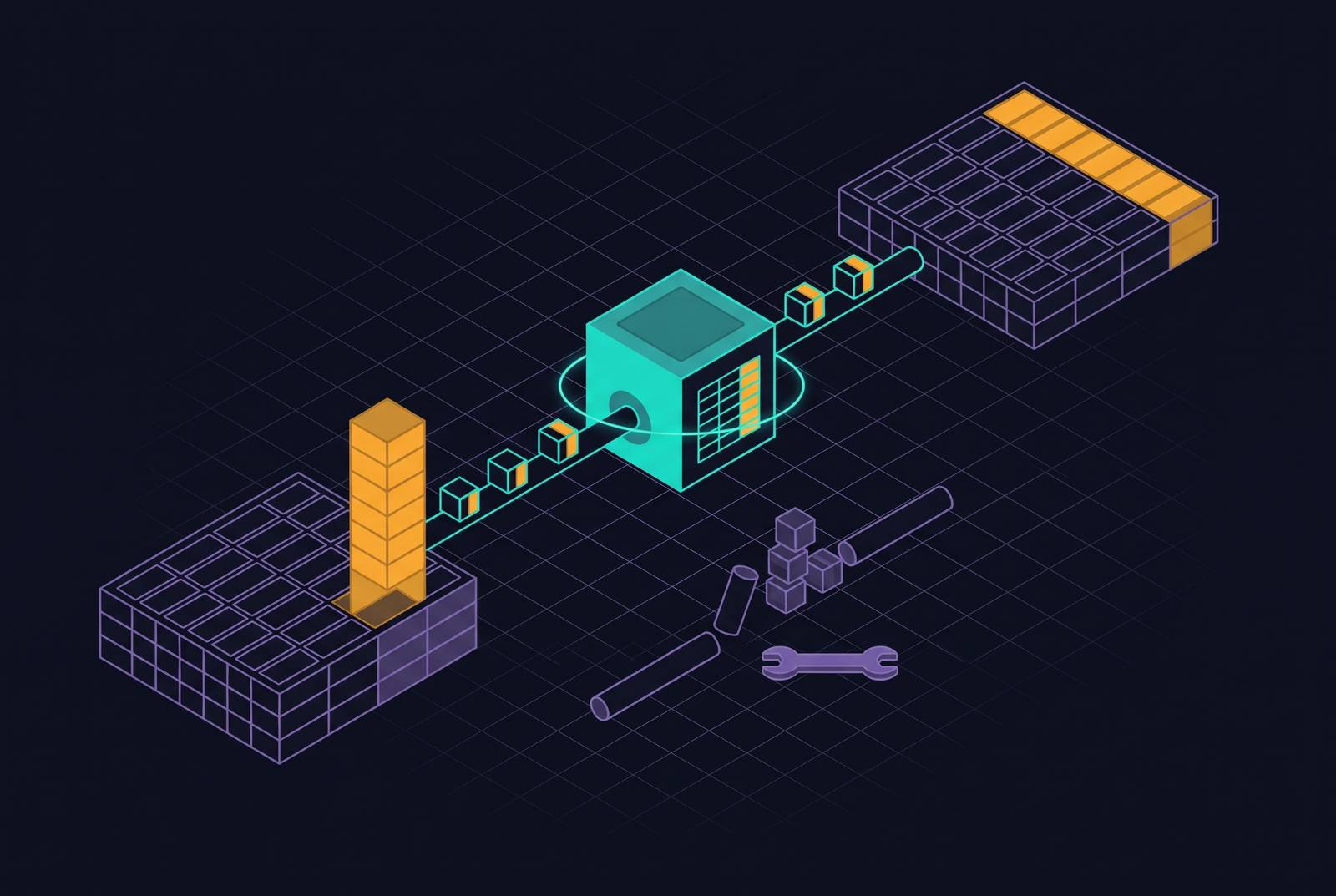
Automatic schema evolution for live CDC pipelines handles upstream table changes by detecting schema changes, updating supported destination schemas, and applying explicit policies to incompatible changes. Unlike manual intervention, schema-aware CDC keeps routine changes from becoming repair incidents. Its advantage depends on the source, destination, and operation supported, with additions generally simpler than renames, drops, or type conversions.
Why schema drift is a pipeline reliability problem, not just a data quality nuisance
Source tables change as developers ship features. They add columns, rename fields, and change data types while downstream pipelines may still treat the old definitions as valid. That mismatch is schema drift, and it can interrupt delivery as well as damage the meaning of delivered data. Without a compatible target schema, the field may be silently dropped or cause an ingestion error.
Type changes and renames pose harder problems. A sink that does not evolve with a source type change can corrupt records, with narrowing and swapping especially difficult to recover from. A rename represented as a drop followed by an add is ambiguous because the consumer cannot infer whether historical values belong to the new field. Repair often starts only when a dashboard breaks, a query returns unexpected results, or a model degrades.
How log-based CDC works and where it leaves schema changes unhandled
Log-based change data capture reads committed inserts, updates, and deletes from the database transaction log, including PostgreSQL WAL and the MySQL binlog. It places minimal load on the source and requires no changes to source table definitions. In PostgreSQL, logical capture uses wal_level set to logical, a publication covering the relevant tables, and a replication slot with an output plugin such as pgoutput or wal2json. The slot also creates an operational obligation. PostgreSQL documents that max_slot_wal_keep_size defaults to -1, permitting unlimited retained WAL, so a stalled consumer can allow pg_wal to fill the volume and stop database writes.
PostgreSQL DDL statements such as ALTER TABLE and CREATE INDEX do not appear in the logical replication stream in the same way as row changes, leaving schema coordination to another mechanism. Other capture methods do not remove that gap. Trigger-based CDC requires trigger definitions to follow schema changes, while query-based CDC cannot reliably detect deletes or capture schema-level events without manual intervention. Log-based CDC handles row events well, but on its own it leaves the target definition stale when source DDL changes that definition.
What manual intervention actually requires when a source table changes
Manual recovery starts when a downstream result is not what was expected. An engineer must first distinguish a schema change from a data quality issue or a pipeline failure. Diagnosis then requires identifying the table, the operation, and the point when the source changed, often through schema comparisons or application deployment logs. Only after that can repair begin. The engineer must pause delivery or accept continued delivery against a stale definition, update the target, resume processing, and validate the result.
Queries and models referencing the old column name or type also need updates, and manual schema migration often requires a pause while changes are applied. During that pause, downstream consumers get stale data or no data at all. With renames, syntax alone cannot tell the engineer what to do. The engineer must establish whether the new field preserves the old field’s meaning, decide whether historical values should follow it, and update dependent references. A pipeline can start running again while a downstream join is still wrong, so successful delivery alone does not show that the repair worked.
How do you handle upstream schema changes without stopping your CDC pipeline?
Schema-aware CDC adds schema-change detection and destination evolution to row replication. It detects changes through the WAL envelope or equivalent log metadata, then propagates supported changes automatically. Azure Data Factory provides a concrete example of this path. Its CDC schema-evolution example adds a PersonalEmail column to an Azure SQL Database source with ALTER TABLE. With Auto Map enabled, the new column flows to the Delta sink without a manual destination alteration.
That example establishes addition support for a specific configuration. It does not establish that every schema operation can pass through every destination without interruption. Type widening can be propagated automatically where supported, while narrowing and swapping require decisions about data fidelity. Renames and drops need equally explicit treatment because a drop-plus-add representation does not establish semantic continuity. Possible policies include carrying historical data forward, filling with nulls, or halting on an incompatible change.
Schema registries complement propagation by validating compatibility at serialization, before incompatible records reach the sink. Transition periods need coordination too. In an expand/contract migration, a nullable column is added, backfilled in batches, and validated while old and new fields coexist. The replication path must handle events that refer to both schema versions without dropping records.
Why AWS DMS illustrates the failure mode of schema-unaware replication at scale
AWS DMS illustrates why migration capability and continuous schema evolution are different requirements. It was optimized for initial full loads followed by basic CDC, a design suited to moving data rather than indefinitely absorbing changing source definitions. That distinction is one of fit. Basic support for adding columns does not mean that drops, type changes, or nested structures have the same level of support. Those more complex operations can need manual intervention or cause replication tasks to stop.
The destination and task configuration shape the failure. When an unsupported production change reaches the replication path, the task may halt, or a configured response may drop and re-create destination tables. Re-creation can remove historical context and break analytics models even when data movement subsequently resumes. As more evolving tables depend on the service, engineers must repeatedly handle the operations it cannot propagate, so a design acceptable for a bounded migration can become a maintenance burden for long-running replication.
How schema-aware CDC changes the economics of pipeline maintenance
Manual schema management creates a recurring cost across source tables, destinations, and downstream consumers. Each change can require an edit to a table definition, diagnosis, migration, validation, and dependent repairs. The burden compounds as the estate grows. Dealing with schema drift can take up much of the work of maintaining pipelines because the same recovery steps come back whenever another source changes. Adding destinations multiplies the places where that sequence must succeed.
Automation changes that cost through determinism. For supported changes, propagation removes the detective work, diagnosis cycle, and repair pause that consume much of the engineering effort. Routine maintenance can consequently fall sharply. Complex multi-table refactors and major version upgrades still need judgment, but teams no longer have to split their attention between those changes and every ordinary column addition.
Engineering time is only part of the exposure. A renamed column can break a join and leave a dashboard misreporting a business metric for weeks. A dropped field can leave nulls in a machine-learning feature without triggering an alert. Those failures can cause harm even when the cost of dealing with the incidents is small. They cost the business money when it makes decisions based on incorrect data.
Why schema drift in feature pipelines is a specific failure mode for AI and agentic systems
Feature stores rely on CDC pipelines to bring them fresh source data. Pipeline latency becomes feature staleness, while a structural mismatch can break the feature itself. A renamed or dropped field is therefore not merely an ingestion concern. It changes what the model receives, potentially degrading outputs even while the surrounding application continues to run.
Agentic data streaming brings that dependency into sharper focus by combining CDC, stream processing, governance, and agent-native APIs. The consumer is no longer necessarily a person reading a dashboard. An agent may act on the data without recognizing that a field has disappeared or changed its meaning. Schema-aware replication is consequently a prerequisite for handling routine structural changes in that architecture.
Correct delivery semantics remain a separate requirement. A source connector cannot guarantee exactly-once results in isolation because retries and duplicates occur throughout production pipelines. The practical design pairs at-least-once delivery from the log with idempotent sink writes and deterministic versioning. Schema transitions must coordinate with those mechanisms to avoid double-counting or missing records. Without that coordination and explicit schema handling, an unrecognized source change can reach autonomous action without a human fallback.
Schema history as a compliance artifact — what HIPAA and SOC 2 require from replication pipelines
Schema-aware platforms that log every DDL change produce an auditable history during normal operation. Repairs done by hand may leave only ad-hoc records, or no records at all. That difference strengthens the evidence available during an audit. It does not, however, make schema history a substitute for security controls or establish compliance by itself. The history records changes to the structure, while the rest of the replication path must still meet the rules that apply to its data.
HIPAA’s documentation standard requires that security documentation be kept for six years. Its audit-control standard does not set a specific log-retention period, so that documentation rule should not be presented as a blanket requirement for every CDC log. Nor does HIPAA establish the claimed requirement that logs be queryable within minutes. The distinction is important when specifying retention policy. Schema-change records can support audit evidence without being described as an independently mandated artifact in every implementation.
The proposed 2025 HIPAA Security Rule changes, published as an NPRM on January 6, 2025, would make encryption of ePHI in transit and at rest mandatory and remove the previous “addressable” flexibility. The proposal is not a finalized requirement. Likewise, SOC 2 compliance evidence should not be taken as proof that every replication configuration meets every rule that applies to it. Schema history contributes traceability, but it does not certify the entire data path.
The architectural recommendation is to use replication as a passthrough. Persisting row data creates a second regulated surface with its own controls. A schema-aware passthrough can retain schema-change history without retaining the replicated rows. That separation supports auditability without creating another persisted copy of regulated data.
When schema-aware CDC is the right choice and when it is not
Schema-aware CDC is the stronger choice when source definitions change frequently and the consequences of an unhandled change exceed the operating cost of the replication stack. Multiple destinations make the case especially clear because each needs the same source change propagated correctly. AI-serving pipelines add the risk of degraded outputs without human detection. Regulated environments also benefit from an automatic schema history, while capacity-constrained teams gain time otherwise spent on routine repairs. These environments turn schema handling into an operational requirement.
When schema changes are rare and long batch windows are acceptable, operating replication slots, WAL retention limits, schema registry versions, and sink idempotency logic can cost more than occasional manual intervention. The value of automation’s operational complexity depends on how often it prevents a more expensive interruption.
A managed schema-aware service shifts that calculation when it handles slot management, WAL retention, schema propagation, DDL detection, and sink delivery semantics. The complexity remains, with the service managing it. That can make automation worthwhile even at moderate change rates. The remaining boundary is semantic change, including multi-table refactors and major upgrades that alter what the data means. Schema-aware CDC makes supported structural changes handled events while preserving human coordination for changes that require interpretation.