Snowflake vs Bigquery vs Redshift for Real-Time Workloads
Snowflake, BigQuery, and Redshift are all managed, cloud-hosted, SQL-compatible analytical databases that share a surface but represent genuinely different architectural philosophies, and their differing concurrency models, ingestion primitives, and latency floors produce meaningfully different outcomes for real-time workloads.
The expensive version of this mistake is not visible on day one. It becomes visible two years in, when the pipeline that seemed fine at launch can't keep pace with the write volume, and a rewrite is now the only option. The criteria to interrogate up front aren't peak query speed, they're sustained ingestion latency, concurrency behavior under real load, and how cleanly each platform handles change data capture (CDC).
At the architectural level, the three diverge sharply. Snowflake separates compute from storage and runs multi-cluster virtual warehouses that scale independently of where the data lives, and it does this across clouds rather than being tied to one.
None of that ranks one platform above the others. It just sets up the terms on which the comparison has to run, because each model has a workload shape it suits, and the comparison shouldn't be framed as one platform winning outright. BigQuery is fully serverless, built on the Dremel engine, GCP-native, and requires zero provisioning.
Snowflake, BigQuery, and Redshift concurrency under streaming load
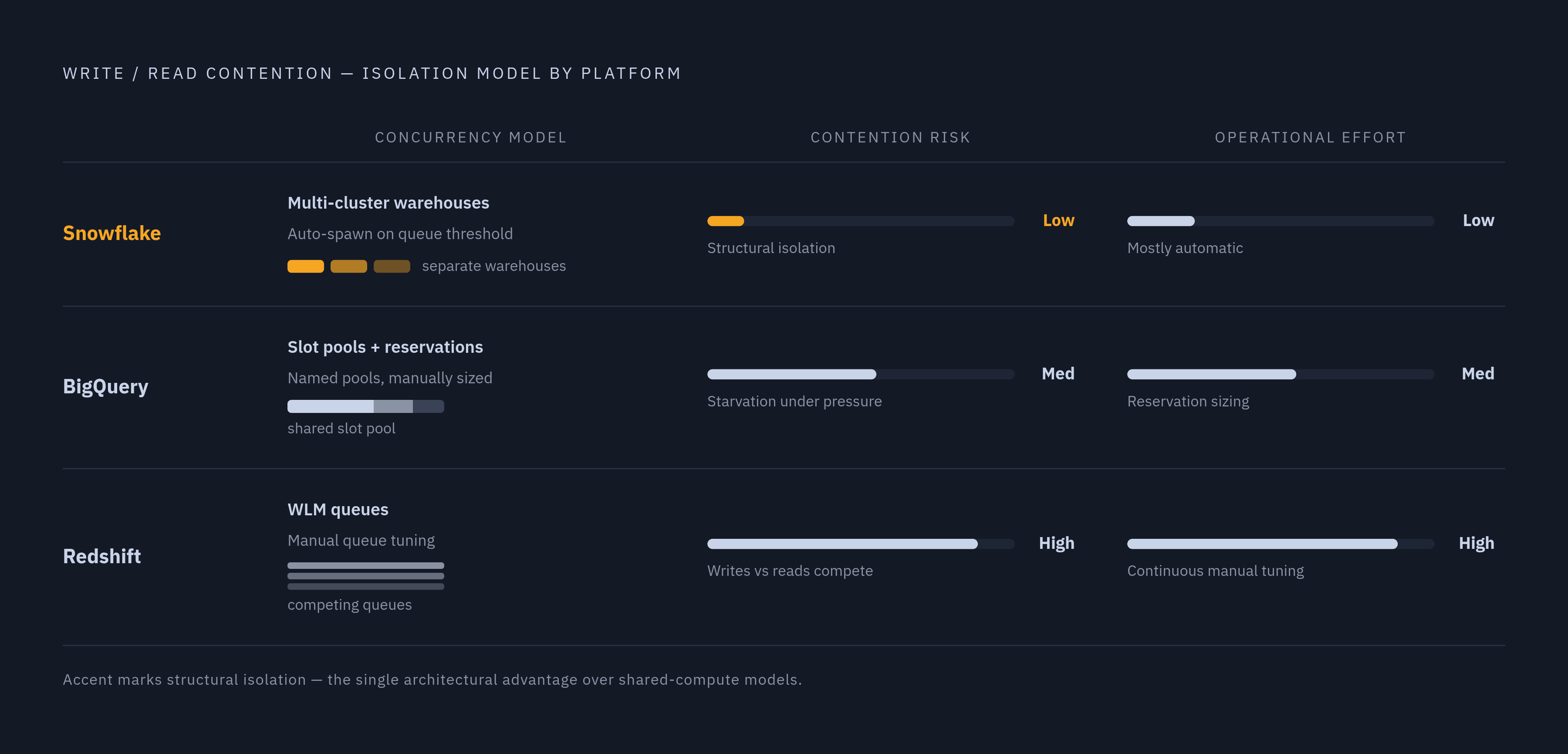
Concurrency is where real-time pressure first exposes what a warehouse is actually built to do. Streaming workloads mean many writers and many readers hitting the same tables at once, and each platform resolves that contention differently.
Snowflake handles it through multi-cluster virtual warehouses that spawn additional clusters automatically once queue thresholds get crossed.
BigQuery pools compute into slots and schedules them across queries. On-demand queries can starve each other when the system is under real pressure. BigQuery offers reservations, letting a team carve slots into named pools reserved for specific workloads. That's a meaningful decision point: a team running a spiky real-time workload has to decide, ahead of time, which slot model it's actually buying, because getting that wrong means unpredictable query latency during exactly the moments latency matters most.
Redshift leans on workload management (WLM) queues to divide up concurrency. Automatic WLM is the current default and handles mixed workloads reasonably well, but when a heavy continuous loader competes with light, frequent reads, that contention still needs manual queue tuning. Of the three, Redshift carries the most operational overhead here.
Put concretely: a workload that streams writes constantly while analysts query the same tables in real time will find Snowflake's isolation model structurally the most forgiving, because separate warehouses on shared storage sidestep the contention entirely. BigQuery works well too, but only once slot reservations are sized to match the actual traffic pattern. None of that makes Redshift or BigQuery a worse platform. It means each concurrency model rewards a different kind of planning.
Snowflake's streaming ingestion layer: Snowpipe Streaming and Dynamic Tables
Snowflake splits real-time ingestion into two distinct primitives, and mixing them up is a common source of confusion for teams estimating what their pipeline can actually do.
Snowflake's own figures put throughput as high as 10 GB/s per table, with data queryable within roughly 5 seconds of arrival. It's also priced on a flat, ingest-based model, so it sidesteps the 60-second compute minimum that otherwise inflates costs on short, frequent queries. Snowflake states that streaming ingest can run as much as 50% cheaper than file-based ingestion at equivalent volume. Openflow extends this further by connecting directly to sources like Kafka and Kinesis, and it can route data back out to those same streaming systems when needed.
Dynamic Tables solve a different problem. They're built for the transformation layer, the staging-to-marts pipeline, not for sub-minute CDC, and that distinction matters. Snowflake's own illustration involves a retailer processing 50 million transactions a day; when 10,000 new orders land, only those 10,000 rows get processed Data Engineer Hub. Converting a batch pipeline into something closer to streaming can be as simple as changing one latency parameter. This layer uses two-step incremental processing: change detection via lightweight streams on base tables, which captures only ROW_ID, operation type, and timestamp, followed by incremental merge on detected changes only.
The 60-second compute minimum applies to warehouse compute, not to Snowpipe Streaming's ingest path. Conflating the two produces cost estimates that are wrong in both directions. Snowflake's streaming ingestion layer includes Snowpipe Streaming. Snowflake's streaming ingestion layer also includes Dynamic Tables.
BigQuery's real-time ingestion via the Storage Write API and CDC
BigQuery's CDC path applies streamed changes as upserts and deletes directly against BigQuery tables in real time, according to Google Cloud's own documentation. Getting there, though, comes with prerequisites that aren't optional.
CDC ingestion requires the Storage Write API over gRPC. The ingestion format has to be protobuf; Apache Arrow isn't supported for CDC. Destination tables need declared primary keys before any of this works. These aren't configuration knobs to adjust later, they're hard constraints, and a team arriving with a pipeline built on the legacy inserts endpoint has real rework ahead, both architecturally and in what it costs to run deduplicated upserts at scale.
The GCP-native path for CDC typically runs Datastream into Pub/Sub and then into BigQuery, with Pub/Sub acting as a decoupling layer so new consumers, an alerting system, an ML pipeline, can attach to the stream without touching the ingestion pipeline itself. For a team already living inside Google Cloud, that's a genuinely strong story. For a multi-cloud team, the same tight coupling to GCP becomes a liability rather than a convenience.
On pricing, BigQuery's on-demand rate dropped from $6.25 to $4.69 per TiB scanned, effective for billing cycles beginning on or after March 1, 2026, a 25% cut that Google positioned as a direct response to competitive pressure. The shape of that pricing model matters more for streaming than the headline number does: on-demand billing rewards spiky, bursty workloads, while flat-rate slot reservations fit continuous streaming better. Teams need to model their actual ingestion pattern against the billing unit before they commit to either.
Redshift's real-time story: what Kinesis and DMS can and cannot do
Redshift's real-time path runs through Kinesis Data Firehose or Kinesis Data Streams for micro-batch delivery, with AWS DMS handling ongoing CDC. That covers a lot of ground, but it stops short of something both Snowflake and BigQuery offer natively.
Redshift has no equivalent of Snowpipe Streaming's row-level ingest API or BigQuery's Storage Write API. There's no sub-second CDC ingestion primitive built into the platform. AWS DMS output typically lands as Parquet files in S3 with a specific layout, and downstream consumers need to understand that layout to use it, because this is a file-staging model, not a row-level push into the warehouse. Redshift Serverless, which reached general availability in 2022 and has matured considerably since, closes the provisioning gap, sparing teams from managing cluster sizing by hand, but it doesn't touch this ceiling on ingestion primitives KoreBPO.
Pricing tells an interesting counter-story. The Serverless floor is $1.50 an hour for a 4-RPU tier, the cheapest entry point among the three platforms KoreBPO Data Engineer Hub. For teams that genuinely don't need sub-second ingestion, that's a meaningful advantage, not a consolation prize.
Redshift's pull also comes from factors beyond price. Its depth of integration with Lambda, Glue, and QuickSight keeps AWS-committed teams on the platform even though the ingestion ceiling limits throughput, because the ecosystem value on the other side of that trade often outweighs it. Redshift is the right warehouse for many use cases. It's the wrong warehouse specifically when sub-minute streaming ingestion is the primary requirement driving the decision.
How CDC delivers changes to a warehouse: log-based, trigger-based, and polling patterns
CDC gets implemented through a small number of patterns, and they are not interchangeable in production.
Log-based CDC reads directly from the database's transaction log, the WAL in Postgres, the oplog in MongoDB, streams in DynamoDB, capturing inserts, updates, and deletes without ever touching the production tables themselves. It's the dominant approach for good reason: it imposes almost no load on the source system doing the actual transactional work.
Trigger-based CDC fires a stored procedure on every change, which offloads detection work from the CDC tooling but pushes real performance overhead onto the database itself. At high write volume, that overhead becomes a genuine liability, and it's generally not the pattern to reach for once traffic gets serious. Timestamp-based polling, comparing a timestamp column on each pass, is the simplest of the three to build, but it misses deletes outright and adds recurring query load to production, which limits it to low-stakes incremental extracts where losing delete events doesn't matter.
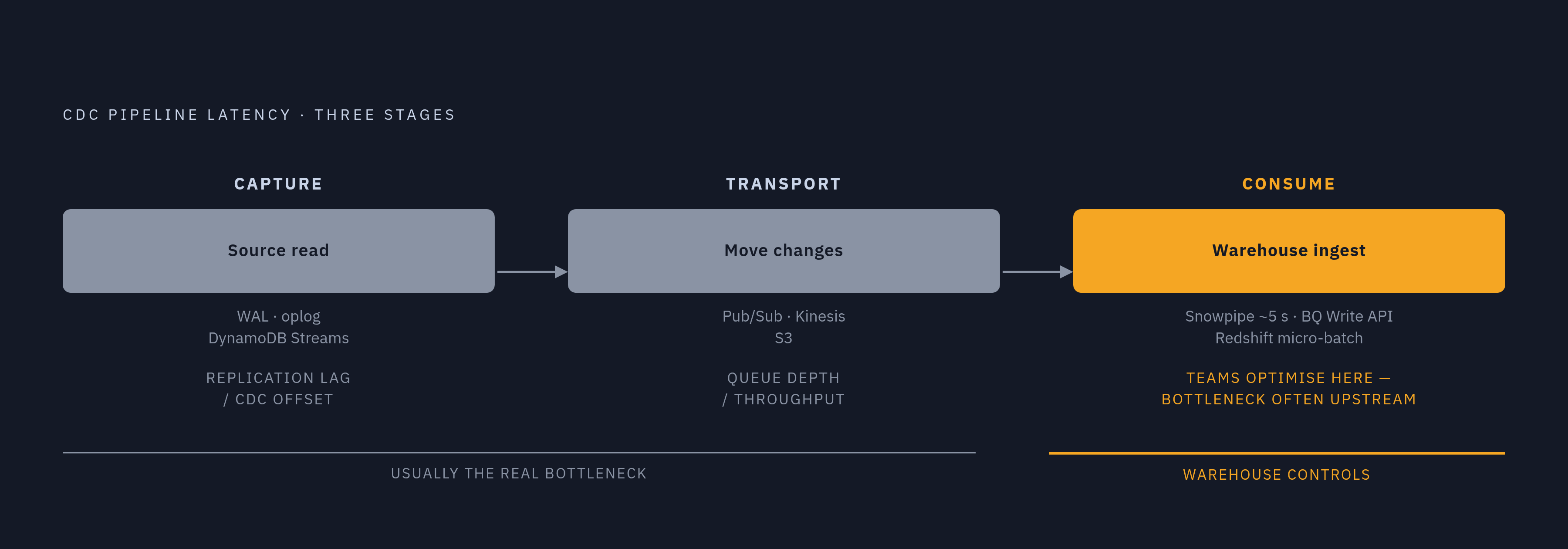
Total latency in any of these setups breaks into three parts: capture, transport, and consume. The warehouse's ingestion primitive, Snowpipe Streaming, the Storage Write API, Kinesis, only controls the "consume" leg. A team that optimizes the warehouse side while ignoring capture and transport will still miss its latency target, because the bottleneck was never sitting where it looked.
On the destination side, teams generally choose between staging data and running a MERGE against the target, or accumulating changes briefly and applying them in micro-batches. Micro-batch apply tends to win on cost and performance once throughput gets high. JSON is easy to work with, but it carries payload size and CPU overhead that binary formats avoid, raising cost and latency once volume climbs. Capture the change stream once at the source, then route it to however many destinations need it, rather than building point-to-point pipelines for each consumer. That approach cuts load on the source database and gets far more reuse out of a single capture mechanism.
Source database mechanics that constrain real-time replication regardless of warehouse choice
The warehouse a team picks doesn't change what the source database demands of a CDC pipeline, and those demands are unforgiving.
Replication slots hold the WAL until the consumer catches up, and an abandoned slot will fill disk in hours, so monitoring is non-optional. Monitoring that slot isn't optional maintenance, it's a production requirement.
As of MongoDB 6.0, change stream events can output document pre- and post-images, useful for audit and reconciliation. The gotcha that catches teams in production: resume tokens expire after 7 days by default on MongoDB Atlas, so production code has to persist the resume token from every event, or a restart after a long outage means the stream can't recover.
A consumer more than 24 hours behind loses that data permanently, since the 24-hour retention window is a hard constraint with no equivalent to a Postgres replication slot holding the log. Shard splits, IAM permissions, and shard iterator semantics all need explicit handling in the consumer's own code. Source database mechanics that constrain real-time replication also include DynamoDB Streams.
None of these constraints shift based on which warehouse sits downstream. They determine what a CDC pipeline has to guarantee before data even reaches the warehouse layer. The buffering and recovery strategy needs to be sized at the source, not bolted on at the destination after something breaks. It reads from the WAL via a replication slot, with pgoutput as the standard output plugin, and protocol versions 1–4 currently supported per PostgreSQL docs. It requires a replica set or sharded cluster and will not work on standalone deployments, meaning teams starting single-node must plan the upgrade before enabling CDC.
Pricing models and the real-time cost traps that appear after deployment
Snowflake's 60-second compute minimum is the clearest example of a pricing mechanic that only reveals itself after deployment. Snowpipe Streaming's flat ingest pricing avoids this entirely, but only for the ingestion path itself, not for the queries run against the data once it lands KoreBPO.
BigQuery's on-demand rate is $4.69 per TiB scanned, down from $6.25. For streaming workloads that scan heavily on every micro-batch, costs can climb fast without deliberate partition and cluster optimization; Reintech has cited a 70% reduction in query cost from partitioning alone, which gives some sense of how much that lever is worth pulling.
Redshift Serverless at $1.50/hr (4-RPU floor) is the cheapest entry point, but the micro-batch/file-staging model means real-time workloads may require more compute hours than a row-level push API would Data Engineer Hub.
MotherDuck's 2026 total-cost-of-ownership study found BigQuery running 57% cheaper than Redshift at the 10TB scale. That's a useful orientation point, but it's a general workload model, not a streaming-specific benchmark, so it shouldn't stand in for actually modeling a team's own ingestion pattern. The real question isn't what the per-TB rate is; it's how a given ingestion pattern, per-row or micro-batch, interacts with whatever unit each platform actually bills on.
Migration outcomes make the point concrete. SmarterX cut its warehouse bill roughly in half moving from Snowflake to BigQuery. Travelpass Group saw a 65% drop in compute costs moving from Databricks to Snowflake. GetYourGuide cut costs 20% moving its Looker workloads to Databricks. Each was solving a different problem, with a different workload shape, and the outcome reflects fit.
The CDC tool layer connecting source databases to each warehouse
The CDC tooling landscape in 2026 runs through several open-source and cloud-native options, alongside AWS DMS, GCP Datastream, and Azure Data Factory as the major cloud-native services.
The fit between tool and warehouse isn't arbitrary. GCP Datastream pairs naturally with BigQuery in a GCP-centered stack: it's serverless, and it chains directly into the Datastream-to-Pub/Sub-to-BigQuery pattern already described. AWS DMS pairs naturally with Redshift for the same reason, running on the same cloud, outputting Parquet files to S3 in a layout that downstream tooling has to be built to understand.
That alignment is worth taking seriously during platform selection, because the ingestion tool and the warehouse aren't independent choices. A team picking Redshift for its AWS ecosystem depth is also, implicitly, picking a pattern that goes with that deep AWS integration, and a team picking BigQuery is picking the pattern where streamed changes are applied as upserts and deletes to BigQuery tables in real time. The warehouse decision and the ingestion architecture decision are really one decision, and treating them separately is how a pipeline that looked fine in testing turns into the rewrite two years down the line that this piece started with.
Sources
- Snowflake vs BigQuery vs Redshift 2026: Data Warehouse Comparison | Reintech media
- Snowflake vs Redshift vs BigQuery: 2026 Comparison
- Snowpipe Streaming and Dynamic Tables for Real-Time Ingestion (CDC Use Case)
- Change Data Capture (CDC) ingestion processing | Google Cloud Cortex Framework | Google Cloud Documentation
- Streaming ingestion to a materialized view - Amazon Redshift